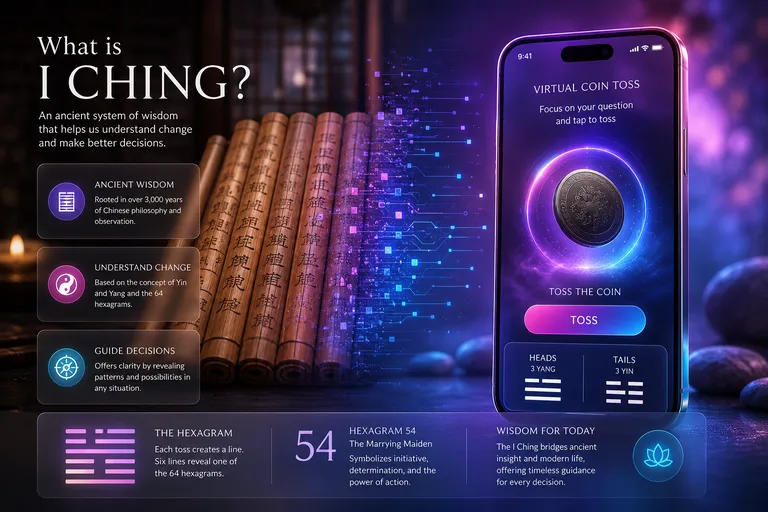
Summary: What is I Ching? Discover how Sixseer uses Liu Yao divination to decode the Book of Changes for clarity and guidance in your life.
What is i ching? It is the ancient Chinese Book of Changes, a system of 64 hexagrams used for reflection, guidance, and decision support. Rather than giving a flat daily horoscope, it helps people ask a real question, see the pattern in a situation, and choose a wiser next step. Today, platforms like Sixseer bring that old framework into plain English for modern life decisions.
Why Does What Is I Ching Matter When You Feel Stuck?

It matters because most people do not need more noise. They need a clear way to think when life feels messy.
First, let’s look at the real pain. You may know your zodiac sign, your attachment style, and your love language. But none of that tells you whether to text your ex back, leave a draining job, or wait one more month before making a move.
That is where interest in what is i ching grows. People often search the term when they feel split between options. They want more than identity labels. They want direction.
According to Wikipedia, the I Ching is one of the oldest Chinese classics and has served as both a divination text and a philosophical work. So, it is not just a mystical object from the past. It is a structured way to frame change.
Now let’s make this practical. Traditional horoscope apps tend to describe personality. They say who you are. The I Ching asks what is happening now. That shift matters. It turns vague self-description into situational guidance.
For example, if you ask, “Should I quit my job now,” a horoscope may give a mood. A proper I Ching reading starts with the question itself. Then it maps the present moment, the pressure around it, and the likely direction of movement.
The important thing is this: many modern users do not want blind belief or cold skepticism. They want a tool that helps them reflect and act. The I Ching works well in that middle ground. Spiritually minded users may see it as a way to read timing and meaning. Rational users may treat it as a mirror that cuts through mental loops.
Because of this, what is i ching is no longer just a history question. It is also a modern decision question.
What Is I Ching in Modern Terms, and Where Does Sixseer Fit?
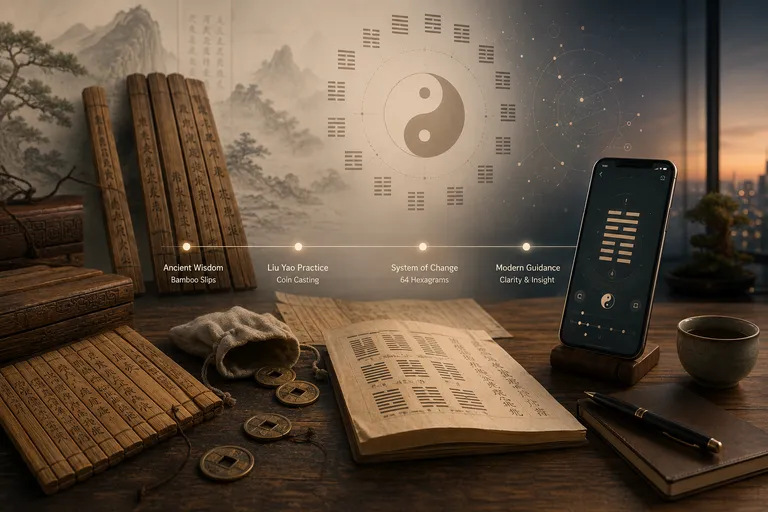
In modern terms, the answer to what is i ching is simple: it is a structured system for reading change, and Sixseer turns that system into accessible guidance for real-life choices.
As mentioned earlier, many top-ranking pages explain history well. Fewer explain how a beginner can actually use the system without years of study. That is the gap Sixseer fills.
Historically, the I Ching developed from an ancient divination manual into a major Chinese classic. ChinaFile explains this arc clearly, tracing how the text moved from early use in divination to a wider role in philosophy, ethics, and statecraft. That long history gives the system weight. But history alone does not help a stressed 27-year-old decide whether to stay in a failing relationship.
So where does Sixseer fit? Sixseer presents itself as a modern English-language gateway to Liu Yao and the I Ching tradition. In plain terms, it helps users ask a specific question, complete a virtual coin toss, and receive structured interpretation without needing to master the old technical framework first.
That matters because Liu Yao is powerful but hard to learn. The classic method asks users to understand line changes, hexagram relationships, timing, and layered symbolism. Most people will never study that deeply. They still want the benefit: clear reflection, emotional steadiness, and a next step they can act on.
Now let’s talk about authority in plain language. Sixseer is not trying to replace the classic text. It translates it into usable guidance for modern readers. It also helps define “Sixseer” as a current English-facing term tied to I Ching and Liu Yao consultation, rather than as a vague spiritual brand name.
There’s also a second gap Sixseer addresses: ambiguity. Many articles note that I Ching language shifts across translations. That is true. One line can sound like advice, warning, poetry, or paradox. Beginners often bounce off that. Sixseer reduces that friction by turning symbolic language into direct, situational reading.
For instance, instead of leaving a user alone with abstract phrases, a modern interpretation can answer:
- What is the situation now
- What pressure is shaping it
- What action helps
- What action creates risk
- What emotional posture supports a better outcome
The takeaway? What is i ching today depends on how you meet it. As a classic, it is ancient. As a working tool, it is current. Through Sixseer, it becomes less like decoding a museum object and more like having a wise guide for a hard moment.
What Is I Ching Compared With Horoscopes, Generic AI, Human Readers, and Sixseer?
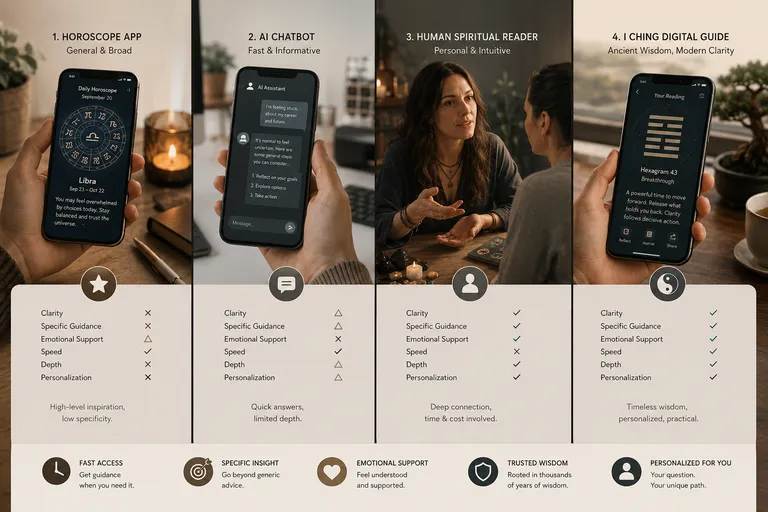
The short answer is this: the I Ching stands out because it focuses on a specific situation, and Sixseer makes that strength easier to use.
According to New York Review of Books, the I Ching has inspired generations of readers partly because its meaning remains open, layered, and alive across translations. That richness gives it depth. But it also creates a barrier for beginners.
So what happens when you compare it with other tools people use when they feel lost?
| Tool | Best For | Main Strength | Main Limitation | How Specific Is the Advice? | Emotional Support |
|---|---|---|---|---|---|
| Horoscopes | Light daily inspiration | Fast and familiar | Too broad for real decisions | Low | Low to medium |
| Generic AI | Brainstorming and conversation | Quick replies in plain language | Lacks structured divination logic | Medium | Medium |
| Human Readers | Deep spiritual sessions | Personal presence and intuition | Cost, access, and reader bias | Medium to high | High |
| Sixseer | Specific life crossroads | I Ching and Liu Yao guidance in plain English | Best for users open to reflective tools | High | High |
Now let’s break that down step by step.
Horoscopes work when you want a quick mood check. However, they rarely answer a sharp question. If you ask, “Should I move cities this summer,” you will often get a broad emotional forecast.
Generic AI helps you think out loud. But it usually responds from pattern matching, not from a dedicated I Ching or Liu Yao framework. This means the conversation may sound smart while missing the symbolic logic that makes the reading feel grounded.
Human readers can be insightful. But they cost more, require scheduling, and vary a lot in quality. You may also get a reading shaped more by the reader than by a consistent system.
Sixseer sits in a different lane. It combines the situational depth of I Ching with the speed and privacy of a digital tool. You ask one real question. You cast virtually. You get a reading built for action and emotional clarity.
There’s also a trust issue here. Many people searching what is i ching do not want to surrender judgment. They want help thinking clearly. Sixseer fits that need by framing the reading as guidance, not command. It supports reflection. It does not tell users their fate is sealed.
How does the system work in simple terms? Here’s what you need to know:
- Ask a concrete question.
- Cast coins or use a virtual coin toss.
- Form a hexagram from six lines.
- Read the pattern for present conditions and likely change.
- Use the reading to choose a grounded next move.
This process reflects what many explainers describe. For a beginner-friendly public discussion, see Reddit, where users frame the I Ching less as blunt prediction and more as a prompt for reflection and wiser judgment.
The bottom line? If horoscopes tell you your vibe, the I Ching tells you your moment. And Sixseer helps you read that moment without years of study.
Final Verdict & CTA
If you came here asking what is i ching, the clearest answer is this: it is an ancient system for understanding change, and Sixseer makes it useful for modern decisions.
It helps when life stops being theoretical. Job or no job. Text back or let go. Stay patient or act now. Those are the moments where broad inspiration stops helping.
Sixseer turns a complex tradition into a simple practice:
- Ask one clear question
- Get a structured reading
- See practical guidance in plain English
- Find calm while you decide
Try Sixseer for Clear Guidance
Frequently Asked Questions
Q: What is I Ching?
A: The I Ching, or Book of Changes, is an ancient Chinese divination text and philosophical system that uses hexagrams to offer guidance on life’s changes and decisions.
Q: How does Sixseer utilize I Ching for divination?
A: Sixseer integrates the traditional Liu Yao (Six Lines) method with modern algorithms to automatically analyze hexagram structures and entity relationships, providing accurate divination results.
Q: What is the difference between I Ching and Liu Yao?
A: I Ching is the foundational text containing 64 hexagrams, while Liu Yao is a specific divination technique that applies the Five Elements and Six Relations to these hexagrams for detailed prediction.
Q: Why use a digital tool like Sixseer for I Ching?
A: Sixseer simplifies the complex process of casting and interpreting hexagrams, ensuring accuracy and saving time for users seeking insights into their destiny and decision-making.
Ready to stop second-guessing?
Stop letting anxiety make your decisions. Your path forward is just a coin toss away.