You’re Allowed to Be Bad at a Hobby You Love
A low-pressure way to test new hobbies by friction, feedback, and how you feel afterward—without turning play into a talent test.
November 21, 2026 · By Sixseer Editorial
This article was prepared with AI-assisted research and drafting under Sixseer editorial and methodology standards.
You do not find the right hobby by being impressive on day one. You find it by noticing which activity makes you a little more present, curious, or alive—even while the result is awkward. If every new hobby becomes a test of talent, the real problem may not be a lack of interests. It may be that play has quietly turned into performance.
Stop asking, “What am I naturally good at?”
A recent Reddit discussion described trying popular hobbies, feeling bad at them, and overthinking so much that the activity created more stress than relief. The hidden fear is painfully familiar: if you are not immediately good, perhaps you chose wrong—or perhaps you are simply not a creative, athletic, or interesting person.
That fear makes a hobby carry far too much weight. A hobby is not an audition for a new identity. UCLA’s Healthy Campus Initiative describes hobbies as voluntary leisure activities that can bring enjoyment or meaning, and notes how perfectionistic standards can strip that enjoyment away. Self-Determination Theory research also distinguishes intrinsic motivation—the interest inside the activity—from pressure, approval, or achievement outside it.
So replace the talent question with a smaller one: What kind of experience would feel nourishing in this season of my life? Maybe you want quiet hands, gentle movement, visible progress, community, or a place for feelings that do not fit into words.
Use the Friction–Feedback–Afterglow test
Instead of searching for one perfect hobby, run three tiny experiments and score each one on these signals:
- Friction: How hard is it to begin? Count setup, cost, travel, noise, social pressure, and the emotional resistance of being new.
- Feedback: Does the activity answer you? A melody changes, dough becomes smoother, a plant stands straighter, or your body learns one movement.
- Afterglow: How do you feel ten minutes later—lighter, steadier, pleasantly tired, mentally spacious, or only relieved that it ended?
Low friction is helpful, but it is not everything. A hobby can take effort and still leave a beautiful afterglow. The strongest clue is often not how skilled you looked during the activity, but whether some part of you wants to meet it again.

Try twenty minutes, not a whole new personality
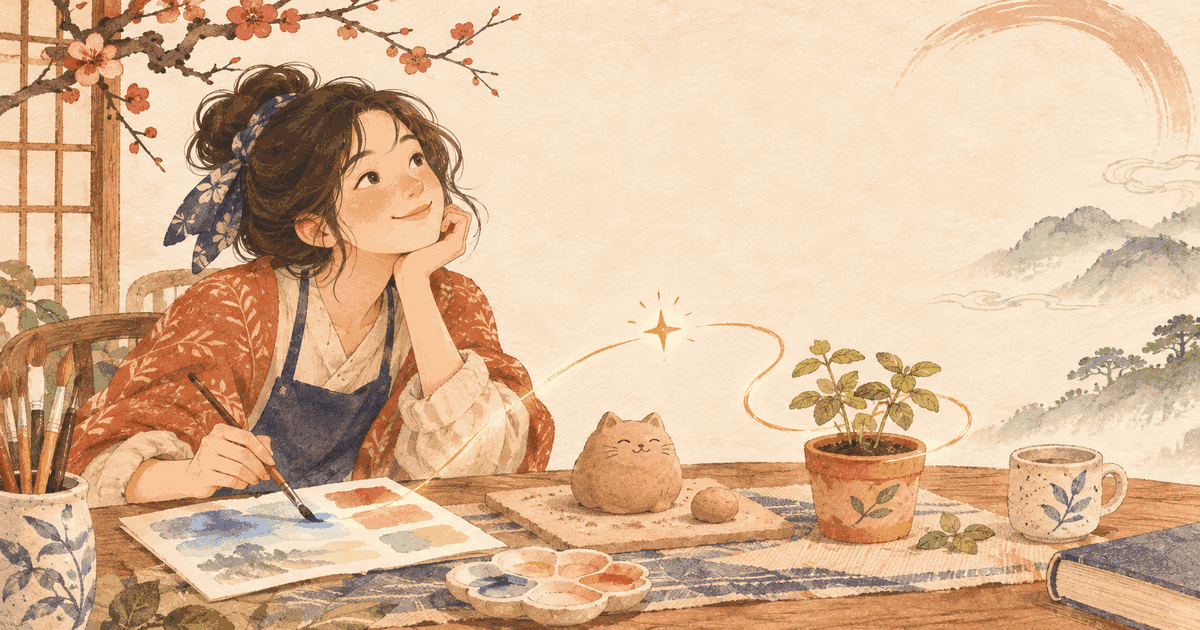
Imagine someone who thinks she should love watercolor because the finished work looks peaceful online. Her first page is muddy, so she decides she has no artistic instinct. Under the new test, she tries one twenty-minute postcard, one herb cutting, and one simple paper fold on different evenings.
The postcard frustrates her, but mixing colors absorbs her. Gardening has almost no pressure and she checks the new roots every morning. Paper folding gives quick feedback but no afterglow. She does not crown a winner. She repeats watercolor and gardening once. That second return reveals more than the first performance ever could.
Keep the trial cheap and reversible. Borrow supplies, use what you already own, follow one beginner lesson, or attend a single community session. Do not buy an aspirational identity before you have tested the actual Tuesday-night experience.

Use I Ching reflection to choose the experience, not predict a talent
If several activities attract you for different reasons, an I Ching reading can help you examine the active pattern: what you are hungry for, where pressure is distorting the choice, and what kind of timing supports a small beginning. It should not declare that you are destined to paint, dance, or garden.
In a focused Sixseer reading for choosing your next experiment, write one clear question. Cast three matching coins six times using one consistent convention, recording the six lines from the bottom upward. Sixseer applies Liu Yao interpretation and AI-assisted plain-language guidance. Reading quality depends on the focused question, consistent casting, correct bottom-up construction, contextual interpretation, and comparison with your real circumstances.
The I Ching’s philosophy of change begins from incomplete knowledge: we act responsibly without controlling every result. That is useful here. You do not need a cosmic guarantee about your forever hobby. You need a clearer next encounter with life.

Try This Question in Sixseer
What should I understand about the kind of hobby experience that would restore my curiosity right now, and what small experiment should I try first?
This asks about your current need, the pressure around choosing, and the next observable step. After the reading, choose one twenty-minute trial within seven days. Write down your expected friction, then record the feedback and afterglow afterward. Let reality join the interpretation.
Frequently asked questions
What if I quit every hobby?
Some hobbies are seasonal. Quitting is information, not a character verdict. Before leaving, ask whether the activity itself stopped fitting or whether cost, setup, comparison, or an oversized goal made it hard to return.
How many hobbies should I test?
Three is enough for a useful comparison. Pick activities with different textures—one physical, one creative, and one quiet or social—then keep each first trial equally small.
Do I need to practice consistently?
Not at first. Repeat only the activity that leaves curiosity behind. Consistency makes sense after fit; forcing a schedule too early can turn discovery into another obligation.
Can an I Ching reading choose my hobby for me?
No. A reading can reveal tension, timing, and a useful next experiment. You still compare the interpretation with cost, access, energy, enjoyment, and what happens when you actually try.
Choose the activity that invites a second meeting
The right hobby does not have to reveal a hidden gift. It only has to create a relationship worth continuing. Let yourself make the lopsided bowl, miss the note, or grow the tiny crooked basil plant. Then notice what remains after the embarrassment passes.
When you are ready, ask Sixseer for clarity about the next playful step—and give the answer a real-world trial before you decide what it means.
Sources