Why Does Your I Ching Reading Get Murkier the More You Read?
If every translation adds another answer, stop collecting meanings. Anchor the question, find the moving pressure, and test one insight against the next seven days.

September 7, 2026 · By Sixseer Editorial
An I Ching reading usually becomes confusing when you keep adding meanings before deciding what the reading is actually answering. The cure is not another translation or forum opinion. Return to one question, identify the part of the situation that is moving, and choose one real-world observation that could confirm or challenge your interpretation.
More meanings can create less understanding
The Book of Changes is layered on purpose. A hexagram can carry an overall image, a judgment, line statements, later commentaries, and centuries of translation choices. That richness is valuable, but it also makes it easy to treat every sentence as equally urgent. The result is a reading that says everything and therefore asks nothing of you.
The Stanford Encyclopedia of Philosophy’s overview of the Yijing explains that the text became both a divination classic and a philosophical work about change. That history helps explain why one reading can support several levels of reflection. Multiple layers are not a mistake; they need an order.
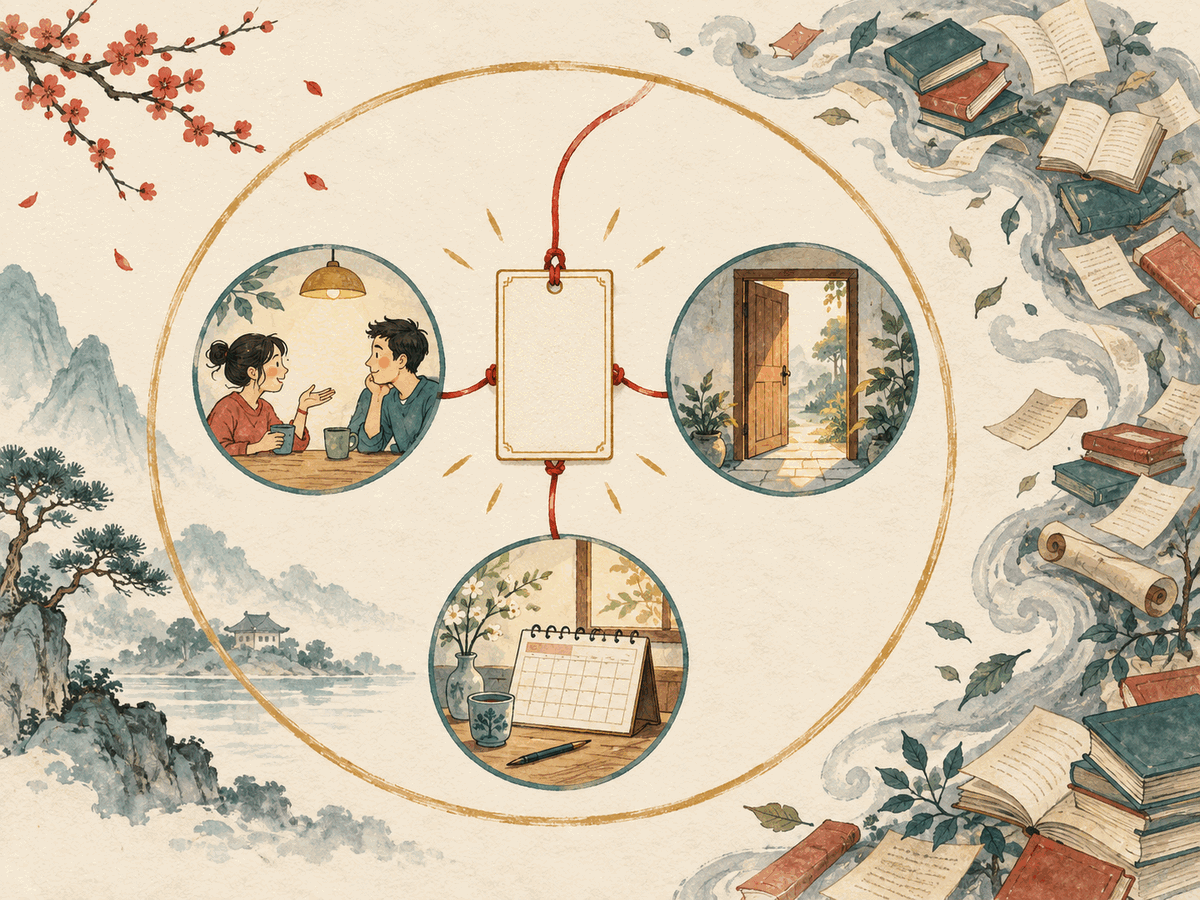
The Anchor–Motion–Mirror method
Use three layers, in this sequence. Do not move forward until you can state the previous layer in one sentence.
1. Anchor: What exact situation did you ask about?
Write your original question above the reading. Then name the decision, relationship, or timing window it contains. “What does my future hold?” has no boundary. “What should I understand before I reply to this offer this week?” gives the symbols somewhere to land.
2. Motion: Where is the pressure changing?
Read the primary figure as the situation’s current pattern. If there are changing lines, treat them as the active pressure—not as unrelated mini-oracles. The relating figure can then suggest the direction created by that movement. In Six Lines practice, correct bottom-to-top construction and the relationship among lines matter because the reading is a structure, not a bag of keywords.
Recent scholarship describes the Yijing as a system of signs used for reflection, apprehension, and anticipation when people face uncertainty. That is more precise than hunting for a fixed prediction: the symbols help you notice what kind of change is underway and what response fits it. See Tze-ki Hon’s 2025 chapter, “The Yijing and the Chinese Philosophy of Divination.”

3. Mirror: What would this look like in ordinary life?
Translate the reading into one observation for the next seven days: a conversation becomes warmer, a delay persists, an invitation returns, or your own urgency softens. This is not forcing the oracle to “prove itself.” It keeps your interpretation honest by comparing symbolism with the actual situation.
A mini-scenario: the offer that suddenly feels urgent
Imagine you receive a creative opportunity and immediately ask whether you should accept. After reading three translations, you can argue for action, patience, danger, and success. Anchor the reading to the decision window: reply by Friday. Identify the motion: is the pressure coming from a real opening, fear of missing out, or missing information? Choose a mirror: request one concrete detail and notice whether clarity increases. The reading now guides attention instead of multiplying opinions.
Let Sixseer hold the structure while you read the pattern
Sixseer is an online I Ching and Liu Yao tool that turns one focused question and six cast lines into AI-assisted, plain-language guidance. For this problem, its value is not producing more material. It keeps the question, casting sequence, six-line construction, changing relationships, timing signals, and practical interpretation connected in one flow.
The quality of a reading depends on a focused question, consistent casting, correct construction, contextual interpretation, and comparison with real conditions. Sixseer’s methodology follows an ask–cast–reflect sequence so beginners can see the pattern currently unfolding without needing to reconcile a dozen disconnected commentaries first.
Try This Question in Sixseer
“What is the central pattern in this reading that I need to understand now, where is the situation actively changing, and what should I observe over the next seven days before I act?”
Cast this focused interpretation question in Sixseer for free, then write your Anchor, Motion, and Mirror before opening another source.

When should you stop interpreting?
Stop when you can name the present pattern, the active tension, and one fitting response or observation. More reading is useful only if it resolves a precise uncertainty—such as a translation term or line position. If it merely gives you another possible story, save it for later. The strongest interpretation is not the one with the most references; it is the one that remains coherent beside your question and your life.
Questions beginners often ask
Should I compare several I Ching translations?
Yes, but compare them after forming a first reading from one trusted text. Use a second translation to clarify a phrase, not to restart the answer. Record what changed in your understanding.
What if two interpretations contradict each other?
Return to the question anchor. Ask which interpretation explains the current pattern and changing pressure with fewer assumptions. Then choose an observation that would distinguish the two.
Do I need to understand every line?
No. Build the six lines correctly and keep the whole figure in view, but give special attention to the lines that are actually changing. Avoid turning every stable line into a separate prediction.
Can I ask the same question again?
Pause first. Recasting immediately can turn uncertainty into a search for permission. Ask again when the facts, decision window, or question has genuinely changed; otherwise revisit the original Anchor–Motion–Mirror note.
Clarity is a thread, not a pile
You do not need to flatten the I Ching into one “correct” sentence. You need a reading whose layers stay connected: one question, one active movement, one honest mirror. If your notes are multiplying but your decision is not getting clearer, begin a free Sixseer reading designed to keep the symbols tied to your real situation.
Sources
- Stanford Encyclopedia of Philosophy: Chinese Philosophy of Change (Yijing).
- Tze-ki Hon: The Yijing and the Chinese Philosophy of Divination (2025).
- Sixseer Methodology — first-party source for the product’s reading flow.
This article was prepared with AI-assisted research and drafting under Sixseer editorial and methodology standards. It does not claim unperformed expert review.