You Don’t Need a Hard Heart—You Need a Better Gate
Kindness does not require instant trust. Use time, pattern, and the real price of your yes to choose openness, a smaller offer, or a clear boundary.

This article was prepared with AI-assisted research and drafting under Sixseer editorial and methodology standards.
Being kind does not require instant trust, unlimited access, or a yes before you have time to think. If you keep laughing off disrespect because you fear becoming cold, the answer is not a harder heart. It is a slower gate: warmth can stay open while access is earned through time, pattern, and how someone responds to a boundary.
Kindness and trust are different permissions
You can be friendly to someone without telling them everything. You can believe they may mean well without handing them your schedule, energy, secrets, or agreement. Kindness describes how you choose to behave. Trust describes how much access someone has earned.
This distinction matters because manipulation often benefits from speed. A rushed request leaves little room to notice your body tightening, remember earlier behavior, or ask what a yes would cost. A sincere person may feel disappointed by your pause, but they can usually tolerate it.
That pause is also where reflection becomes useful. The Stanford Encyclopedia of Philosophy’s account of the Yijing describes divination as a moment to review the past, examine the present, and prepare a next move under uncertainty. It is not surveillance of another person’s hidden mind. It is a way to become more honest about the pattern you are already inside.
Use the Time–Pattern–Price gate
Before saying yes, run the request through three filters:
- Time: Do I have room to decide, or am I being pushed to answer now? Try: “Let me think about that and get back to you tomorrow.”
- Pattern: Is this a one-off need, or does this person repeatedly take, tease, pressure, disappear, or ignore small noes?
- Price: Would helping require me to abandon rest, privacy, money, another commitment, or my own sense of safety?
A green light is not “I feel guilty, so I should.” It is enough time, a respectful pattern, and a price you freely choose. Yellow means reduce the offer. Red means the request depends on pressure, secrecy, punishment, or crossing a limit.
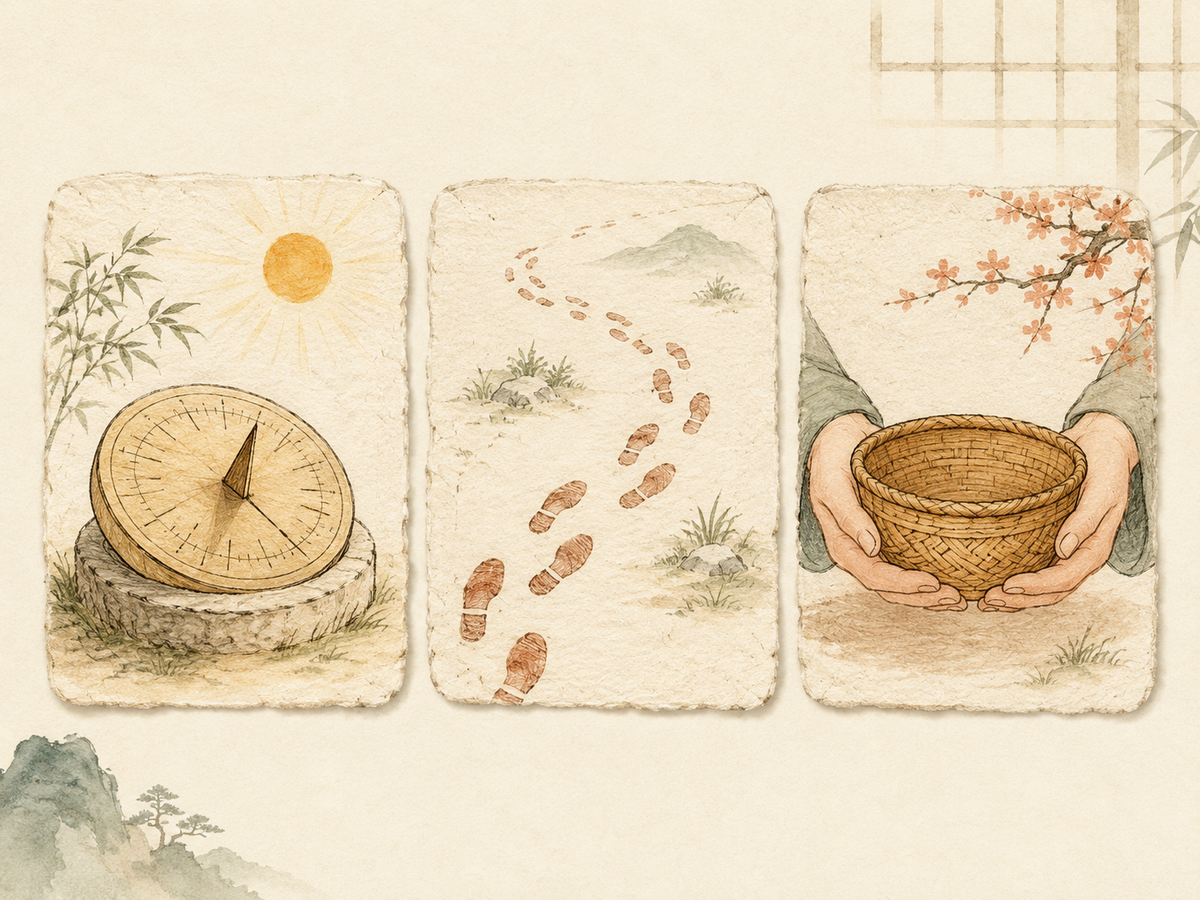
Imagine a new friend asks for a large favor after two intense weeks of closeness. Your old move is to agree instantly so you do not seem selfish. The gate move is to wait overnight, look at whether care has gone both ways, and offer something smaller: “I can help for an hour, but I cannot take the whole thing on.” Their response gives you new information.
Let a small boundary reveal the pattern
You do not need a courtroom case before setting a limit. Start with something proportionate: delay your answer, decline one part, ask a clarifying question, or name the joke that did not feel funny. The NHS guidance on healthy relationships recommends open conversation and boundaries around what you are actually able to offer.
Then watch behavior. A healthy person might negotiate, feel disappointed, or need a moment—but they still recognize your right to choose. Someone who mocks, guilt-trips, escalates, or treats your limit as betrayal is not proving that your boundary was unkind. They are showing why it was needed.

Try This Question in Sixseer
If your mind keeps switching between “trust everyone” and “trust no one,” ask about your position and timing instead of demanding a verdict on another person. Cast a free Sixseer reading for this exact boundary question:
What should I understand about the pattern between my wish to be kind and my need for self-protection, and does this situation support openness, a smaller offer, or a clear boundary?
A focused question improves the usefulness of the reading. Cast the coins consistently, build all six lines from the bottom upward, and let Liu Yao interpretation examine relationships within the line pattern. Sixseer then provides AI-assisted plain-language guidance. Compare that guidance with real circumstances: the request’s pace, the person’s repeated behavior, the price of your yes, and what happens after a small limit.

Frequently asked questions
Does setting boundaries make me less kind?
No. A boundary makes your help honest and sustainable. UC Berkeley’s Sustaining an Open Heart practice treats openness and emotional boundaries as two capacities needed for healthy connection.
What if I cannot tell whether someone is joking or disrespecting me?
You can ask plainly: “What did you mean by that?” or say, “I know you may be joking, but that did not feel good to me.” You do not need to prove intent before naming impact.
Should I trust my gut?
Treat a body signal as information, not a complete verdict. Slow down, check the observable pattern, and choose a proportionate next step.
Can an I Ching reading tell me if someone is manipulating me?
Do not use a reading as proof of another person’s secret motives. Use it to reflect on timing, pressure, reciprocity, and the action available to you. Sixseer’s methodology frames readings as decision support, not fixed prediction.
Stay soft, choose the door
Your kindness is not the problem. The missing skill may simply be deciding who receives how much access, and when. Keep the warmth. Add time. Believe patterns. Respect the price of your yes. When a situation still feels tangled, use Sixseer to find the calmest boundary-sized next step.
Sources