The Friendship Changed. The Music Is Still Yours.
A changed friendship does not have to close the places you love. Make a One-Set Agreement, keep encounters brief, and choose an outing that belongs to you.

September 17, 2026 · By Sixseer Editorial
Going to a concert alone can be worth it even when a friendship has become awkward. You do not need to repair the relationship before enjoying music you love. The useful question is whether you want the experience itself—and what would make one manageable visit possible without turning the evening into a test of whether you still belong.
This article was prepared with AI-assisted research and drafting under Sixseer editorial and methodology standards.
Separate the ticket from the friendship
A falling-out can make a shared venue feel like someone else’s territory. You picture the entrance, their group, the moment you might stand alone. Suddenly, a show becomes a referendum on your social life.
Try this: if that friend definitely would not be there, would you still want to hear the music? A yes gives you an independent reason to go. A no may mean you are hoping the event will deliver recognition, an apology, or proof that you are missed. Those hopes deserve attention, but a crowded room is a difficult place to resolve them.
Make a One-Set Agreement with yourself
You do not have to promise an entire night of effortless confidence. Promise a bounded experience: arrive, listen to one performance, then decide whether to stay.
Sixseer, an online I Ching and Liu Yao tool, can help you reflect on the tension between returning to something you love and protecting a tender boundary. First, give that tension a practical shape:
- Your reason: Name what you are going for: a particular performer, a sound, or the pleasure of being there. “Make them see I’m fine” is a different assignment.
- Your arrival anchor: Check entry details, choose a comfortable viewing area, and know how you will get home. Give the first few minutes a job other than scanning for your friend.
- Your release: After the set, you may stay or leave. Leaving on your own terms does not cancel the experience.
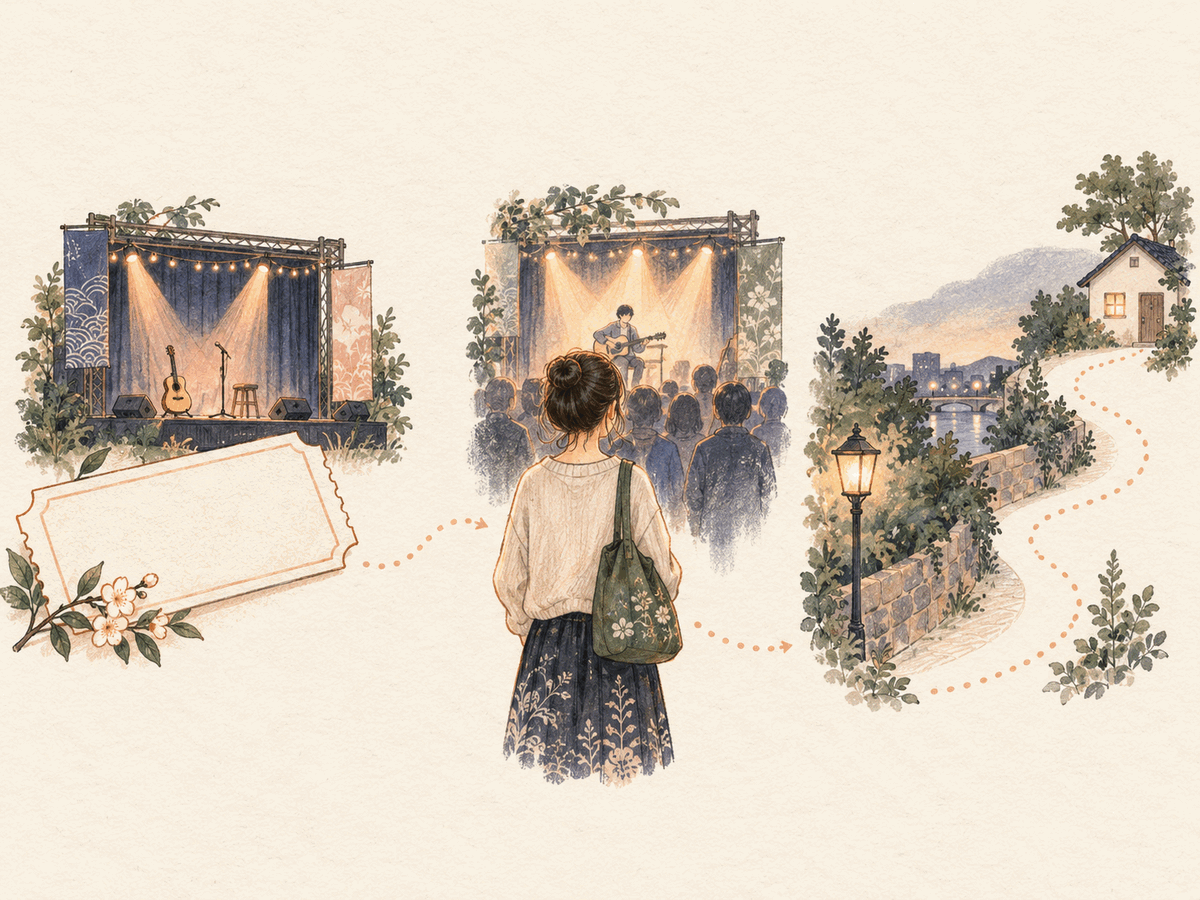
This is an editorial planning exercise, not a research-tested protocol. If the concern involves threats or harassment rather than ordinary awkwardness, this small social experiment is not the right frame.
Awkward in your imagination is not the whole forecast
Research by Rebecca Ratner and Rebecca Hamilton examined reluctance to do enjoyable public activities alone. In an art-gallery experiment described by Georgetown University’s account of the research, solo visitors expected a worse experience but enjoyed it as much as accompanied visitors. That does not promise a perfect concert. It does suggest your prediction may undervalue the activity itself.
You can feel exposed at the door and absorbed by the second song. Both can happen in the same evening. You also do not have to recruit a replacement best friend before buying a ticket.
If you see them, keep the moment small
Imagine you arrive just before the performance. You spot your old friend near the back. Your stomach drops; you nearly leave. Instead, you move toward your chosen viewing spot. If your paths cross, “Hi—I’m here for the set. Enjoy the show” is enough.
If they want a heavy conversation, try: “I’m not up for talking about that here.” A civil hello is not renewed closeness. Staying elsewhere in the room is not a public punishment.

Let any friendship decision happen separately, when you can judge respect and responsiveness. Our guide to deciding which friendship differences need distance is useful if the awkwardness reflects a deeper mismatch, not just tonight’s seating arrangement.
Try This Question in Sixseer
What should I understand about returning to this music event after our friendship changed, and does the present timing support going for one set independently, inviting someone else, or choosing a different event while I keep some distance?
Explore the timing of this solo outing in Sixseer. Ask about your participation and boundaries, rather than whether everyone will approve of you.
The I Ching tradition explores change through six-line figures. Liu Yao brings a more detailed relational and timing framework to the question. If those names are new, start with how the I Ching and Liu Yao fit together.
Hold one focused question, cast three coins six times using the same counting rule, and build the six lines from bottom to top. Reading quality depends on that consistency, correct construction, contextual interpretation, and comparison with real circumstances. Sixseer’s methodology combines casting and interpretation with AI-assisted plain-language guidance.

Use the reading to examine where interest meets hesitation and what kind of participation feels proportionate. Then check something observable: can you enjoy the set without monitoring their reaction? If you leave, was it because you had enough—or because one glance became a verdict?
A few questions before you go
Is going to a concert alone weird?
No. It simply means your interest does not currently come with a companion. Feeling conspicuous is not proof that other people are judging you.
Should I tell my former friend I’m going?
Not for an ordinary public event where you need no invitation from them. If there is a shared ticket or an existing plan, clarify that practical arrangement directly.
What if I don’t talk to anyone?
The music still counts. New connections are a possibility, not an attendance requirement. If you later meet someone you like, build closeness through small, mutual invitations rather than trying to solve your whole social life that night.
Can a reading tell me how my friend will react?
It can offer a symbolic perspective on the situation, not verified access to their thoughts. Keep your plan workable even if their response is neutral or absent.
Keep something that belongs to you
You may miss the friendship and still love the music. Let those truths coexist. Bring your next small step to Sixseer for a calmer, more focused choice—then let the evening be an experience, not an audition.
Sources
- Georgetown University: solo-activity research, linked above.
- Stanford Encyclopedia of Philosophy: Yijing background, linked above.
- Sixseer Methodology: product process, linked above.