Can Love Be Real When the Future Is Already Closed?
Love can be real while the shared future is closed. Use Present–Possible–Price to test what can change, name the cost of waiting, and choose honestly.

Relationship clarity
October 2, 2026 · By Sixseer Editorial
Love can be real and the relationship can still have no workable future. If one of you has named a firm condition for marriage, family, place, or belief—and the other cannot honestly meet it—the pain is not confusion. It is the clash between a beautiful present and a future that asks someone to disappear.
Love can be true without being buildable
The hardest part is that nothing dramatic may be wrong today. You laugh, feel safe, make dinner, send the good-morning text. Then one sentence waits behind every ordinary moment: “We are not building toward the same life.” Staying is not automatically foolish, and leaving is not proof that the love was fake. The useful question is whether the relationship has a bridge—or only a pleasant waiting room.
A one-year study of 148 married and cohabiting couples found that better coordination of personal goals predicted later progress on shared projects, which in turn was associated with life satisfaction. That does not decide any individual relationship, but it supports a practical point: affection and a workable shared direction are different resources. Read the longitudinal study on couple goal coordination.
Read the relationship in three tenses
Use Present–Possible–Price before asking for another promise or another year.
Present: What is genuinely good now, without using it as evidence that the future will change?
Possible: Is the future condition open to negotiation, dependent on a real event, or already closed?
Price: What does waiting cost in time, options, resentment, or trust in your own needs?
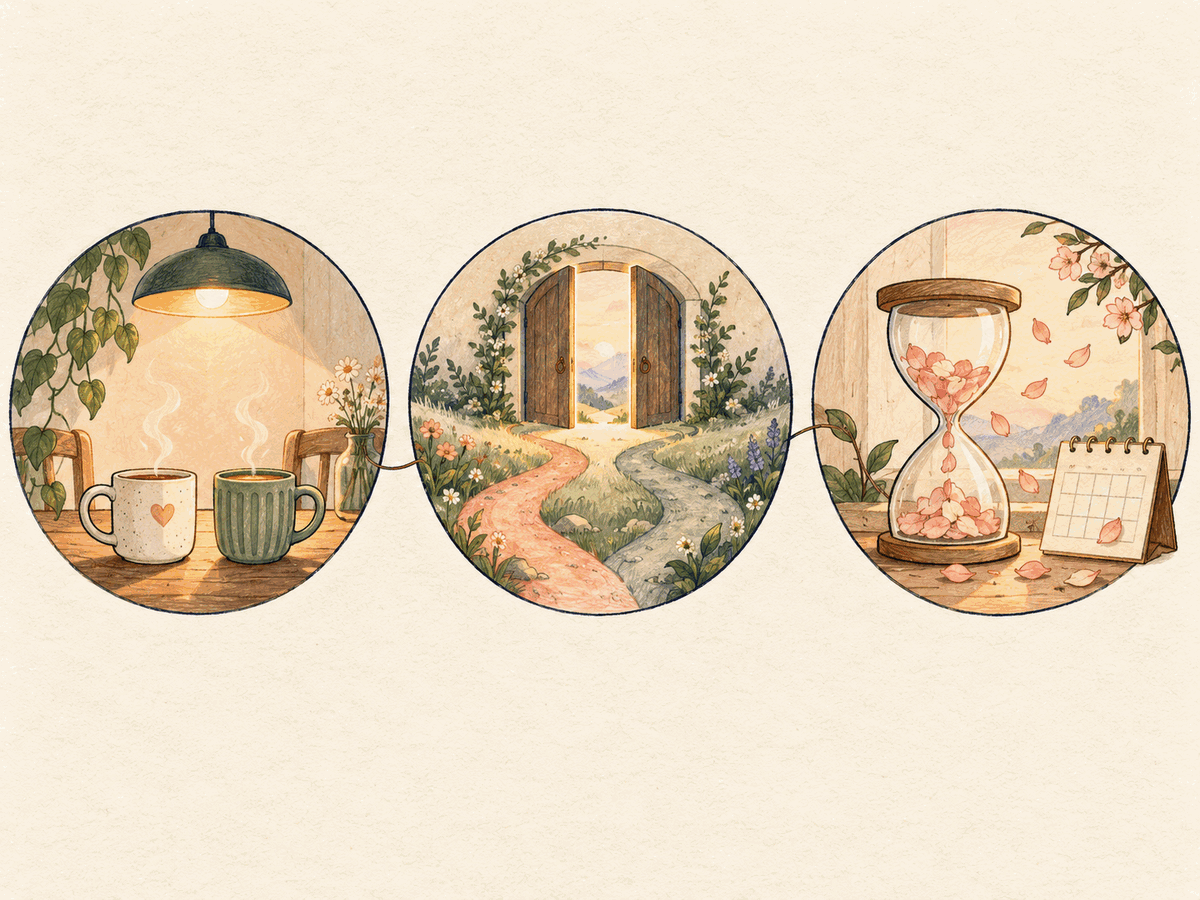
The middle answer matters most. “Maybe someday” is not a bridge unless both people can name what would be reconsidered, by when, and without asking either person to betray a core value. If two honest futures may still connect, the Two Yeses and a Bridge Test shows how to look for a path that does not erase either life. If the destination is shared but the route differs, see how couples can protect a future without pausing one life.
A clarity window is not an endless extension
Imagine this: Sunday night, you are choosing a show while both avoiding the future conversation. Instead of reopening the whole relationship, you agree to one calm talk next Saturday. Each person brings three notes: what cannot change, what can change, and what evidence would make a shared future credible. The goal is not to win. It is to stop borrowing peace from a deadline neither of you will name.

A short, agreed season can be kind when it has a purpose and an end date. It becomes self-abandonment when one person keeps waiting for a closed condition to soften while the other enjoys the present without carrying the same future cost.
Ask about the threshold, not whether love is real
Sixseer is an online I Ching and Liu Yao, or Six Lines, tool that turns one focused question into coin casting, a correctly built six-line reading, and AI-assisted plain-language guidance. Beginners can explore it free. For a grounded introduction, use the plain-English guide to I Ching and Liu Yao.
The I Ching is useful here because it studies change: pressure, relationship, movement, timing, and what an action may set in motion. The Stanford Encyclopedia of Philosophy overview of Chinese change explains the tradition’s long connection to reflection and decision under uncertainty. A reading is not a vote on whether your love is “meant to be.” Its practical accuracy depends on a focused question, consistent casting, correct six-line construction, contextual interpretation, and comparison with the real situation.
Try This Question in Sixseer
What should I understand about staying in this loving relationship when our future conditions do not align, and does the present timing support one honest negotiation, a defined ending, or a short agreed season before we part?

Write the question once. Cast consistently. Then translate the reading into one observable step: schedule the conversation, set the decision date, or name the condition you will not cross. Sixseer helps surface the unfolding pattern; your real-life evidence tells you whether the pattern is actually changing.
Questions people ask when love has an expiration date
Is it wrong to stay if we both know it may end?
No—if both people understand the same reality and consent to the same terms. It becomes unfair when one person treats the season as complete while the other is quietly investing in a reversal.
How long should a clarity window last?
Long enough to gather the specific evidence you agreed to observe, not long enough to avoid the answer. Choose a real date and a real decision; “after things calm down” is not a date.
Can an I Ching reading tell me to break up?
It can illuminate timing, tension, likely movement, and risk. It should not replace consent, facts, or your values. Use the reading to sharpen the next honest action, not to hand away responsibility.
What if the relationship is the healthiest one I have had?
Honor that truth. A relationship can teach you safety and still not be your permanent home. Leaving because the future is closed does not cancel what was good; it refuses to make gratitude a lifelong contract.
You do not have to make the love false
The choice is not “believe in us” versus “give up.” It is whether the present can mature into a future both people can inhabit. Name what is fixed, test what is genuinely possible, and count the price of waiting. Then use Sixseer to find the next honest relationship step—negotiation, a time-bounded season, or a clean ending that lets real love remain real.
Sources
- Flourishing Together: Couple Goal Coordination and Life Satisfaction (2023).
- Chinese Philosophy of Change (Yijing), Stanford Encyclopedia of Philosophy (substantive revision 2023).
- Sixseer Methodology for first-party product and interpretation details.