Should I Quit My Job? An I Ching Decision Reading
Turn career uncertainty into clarity. Sixseer’s I Ching reading maps your situation to Act, Wait, Prepare, or Adjust — practical guidance, not fortune-telling.

The I Ching does not give a simple yes-or-no to “should I quit my job.” A Sixseer decision reading maps your situation to a hexagram signal and one of four practical postures — Act, Wait, Prepare, or Adjust — so you can move forward with clearer awareness of timing, hidden resistance, and what step to take next. Sixseer uses a simplified decision-support interface inspired by I Ching / Six Lines (Liu Yao) to turn a career dilemma into a structured signal, without claiming to predict outcomes.
Four Decision Postures: Act, Wait, Prepare, Adjust
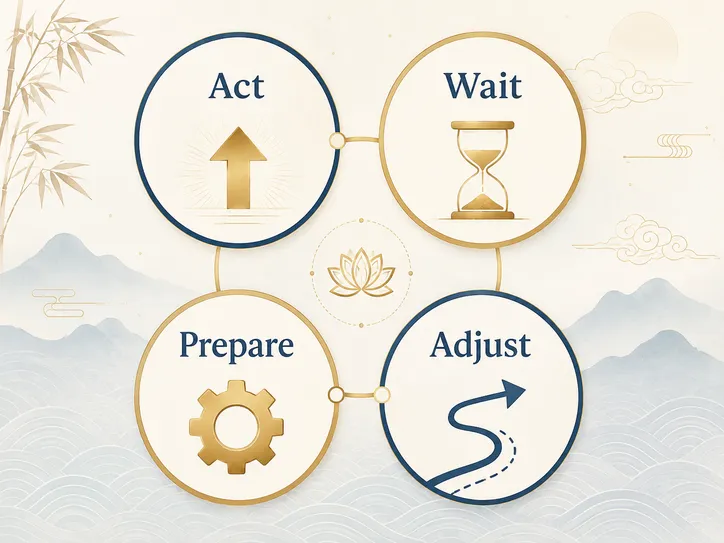
When Sixseer processes your career question, it maps the hexagram’s signal to one of four practical postures. Each represents a different relationship between your current momentum and the direction you are considering — reads on alignment, timing, and what the present moment may support.
| Decision Signal | What it may suggest | Practical next step |
|---|---|---|
| Act | Conditions appear to favor forward movement. Energy is aligned with action; further delay could miss a window. | Take one concrete step this week: update your resume, have an exploratory conversation, or set a clear timeline for your transition. |
| Wait | Momentum is not yet ripe. Unseen factors may still be developing; acting now could meet unnecessary resistance. | Pause major decisions for a defined period, such as 30 days. Observe patterns at work and gather information you are currently missing. |
| Prepare | The situation calls for groundwork before moving. You may need more resources, skills, or clarity for a smooth transition. | Identify one gap — financial cushion, certification, network connection — and begin closing it. Return to the reading once that piece is in place. |
| Adjust | The goal itself may need reframing. Leaving may not be the only path; changing your role, expectations, or approach could shift the dynamic. | Re-examine what you are really trying to escape or find. Consider whether a lateral move, a conversation with leadership, or a shift in how you engage could resolve the tension. |
Each posture includes a risk flag in a full Sixseer reading — a “what to watch for” note that helps you stay alert to blind spots, such as impulsive action, prolonged hesitation, or mistaking preparation for avoidance.
Start an I Ching Decision Reading to see which posture matches your specific situation.
What a Hexagram May Reveal About Timing and Readiness
Beyond the four postures, a hexagram reading often carries secondary signals about timing, resistance, and the broader picture.
Timing indicators: A hexagram may suggest whether the current moment holds momentum or whether a natural shift — a project completion, a seasonal change — would alter the landscape. Some hexagrams point toward quick movement; others counsel patience until conditions change.
Resistance points: Internal doubt, external pressure, or overlooked information can distort how you see your options. The reading may highlight where fear of change or fear of staying is coloring your judgment, or where someone else’s expectations are weighing on your decision.
Situational awareness: The hexagram helps you see the fuller picture. Your frustration may not be about the job itself but about a skill you have not developed, a conversation you have not had, or a season of life that is temporarily draining your energy. These insights make your decision more informed.
Responsible Use
Sixseer provides decision guidance informed by I Ching patterns, not life directives. The reading sharpens awareness and clarifies options — it is not a substitute for professional advice. For legal, financial, or mental-health concerns, consult a qualified professional. Use the reading as one input among many, and let your own judgment remain the final authority. See our Trust & Safety Guide for more context. When you are ready, start an I Ching decision reading for your specific situation.
Can the I Ching tell me if I should quit my job today? No — the I Ching does not give a simple yes-or-no. A Sixseer reading points you toward one of four postures (Act, Wait, Prepare, Adjust) so you can decide with sharper awareness of timing and hidden dynamics.
What hexagram suggests it is time to leave a job? No single hexagram means “quit now.” Several hexagrams — involving movement, breakthrough, or crossing — may suggest forward action is aligned, but the meaning depends on the full reading context, including moving lines and your specific situation.
How is Sixseer’s I Ching reading different from a tarot career spread? Sixseer draws on I Ching / Six Lines (Liu Yao) logic rather than tarot. The output is a structured decision signal — situation snapshot, resistance points, timing read, and a recommended posture — rather than open-ended card interpretation.
Do I need to know I Ching hexagrams before using Sixseer? No. Sixseer’s interface translates the hexagram into plain, practical guidance. You only need to bring a clear, concrete situation you are wrestling with — the tool handles the rest.
Start an I Ching decision reading
Last reviewed: July 2026.