How the Five Elements Make a Liu Yao Chart Move
A visual beginner’s guide to the Five Elements in Liu Yao: how generating and controlling relationships shape support, pressure, timing and line strength.
October 7, 2026 · By Sixseer Editorial
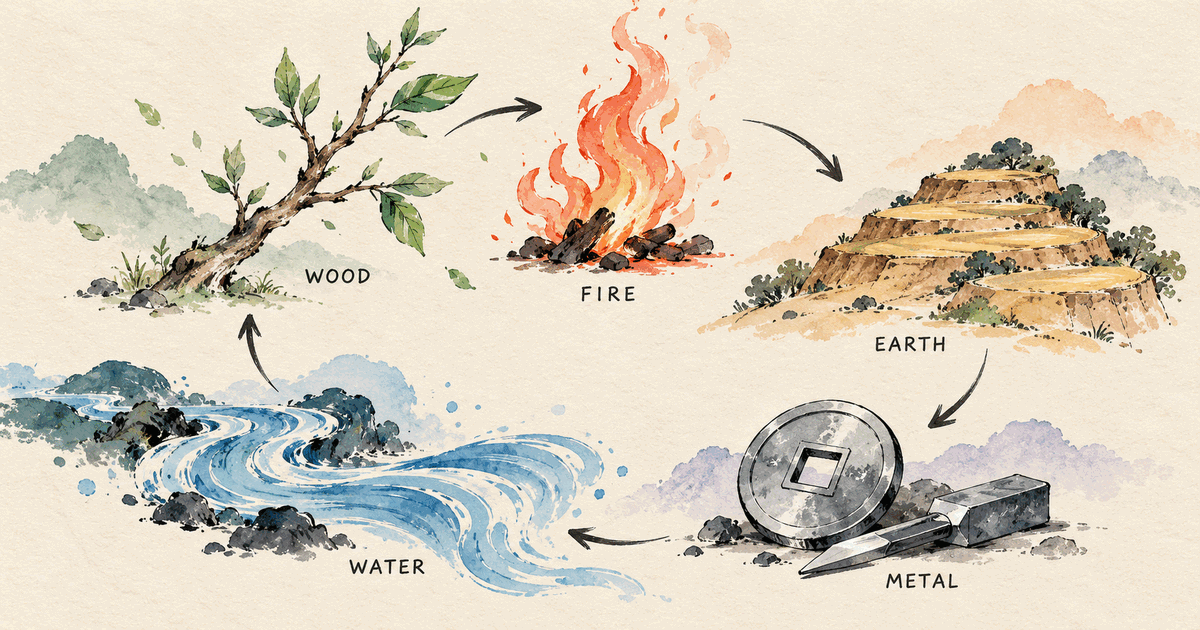
The Five Elements in Liu Yao are not five objects hiding inside a chart. They are a relationship system: one phase supports another, one applies pressure, and the same phase can become an ally or a rival. Learn those relationships and the chart stops looking like a list of labels—it starts showing movement.
Think in phases, not literal substances
Wu Xing (五行) is commonly translated as “Five Elements,” but “five phases” or “five processes” is often closer to how the system works. The Internet Encyclopedia of Philosophy’s overview of Wuxing likewise emphasizes movement, alteration and changing states rather than a Greek-style list of physical ingredients.
In a Liu Yao chart, Wood, Fire, Earth, Metal and Water label the six lines after the traditional calendrical and symbolic correspondences are applied. They help describe how the people, goals, resources and pressures represented by those lines affect one another. If you want the wider method before the details, start with this beginner explanation of Liu Yao.
The generating cycle: where support flows
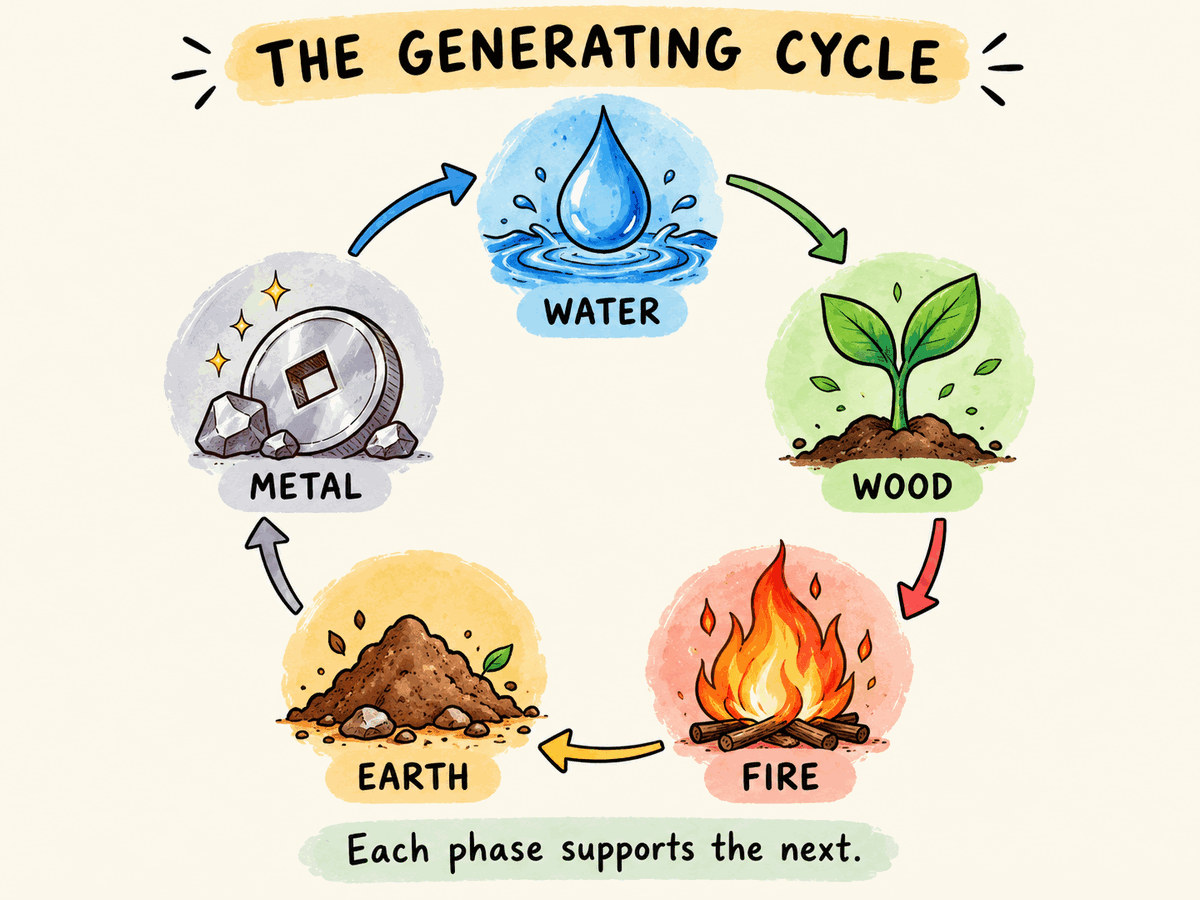
The generating cycle (xiang sheng, 相生) describes support. Water nourishes Wood; Wood fuels Fire; Fire leaves ash associated with Earth; Earth bears Metal; and Metal generates Water in the traditional sequence. These are teaching images, not claims of modern physical causation.
The phase that generates another is often called its “mother”; the phase it generates is its “child.” In a reading, that vocabulary lets an interpreter quickly ask: what is supplying this line, and where is this line spending its energy?
The controlling cycle: pressure can be useful
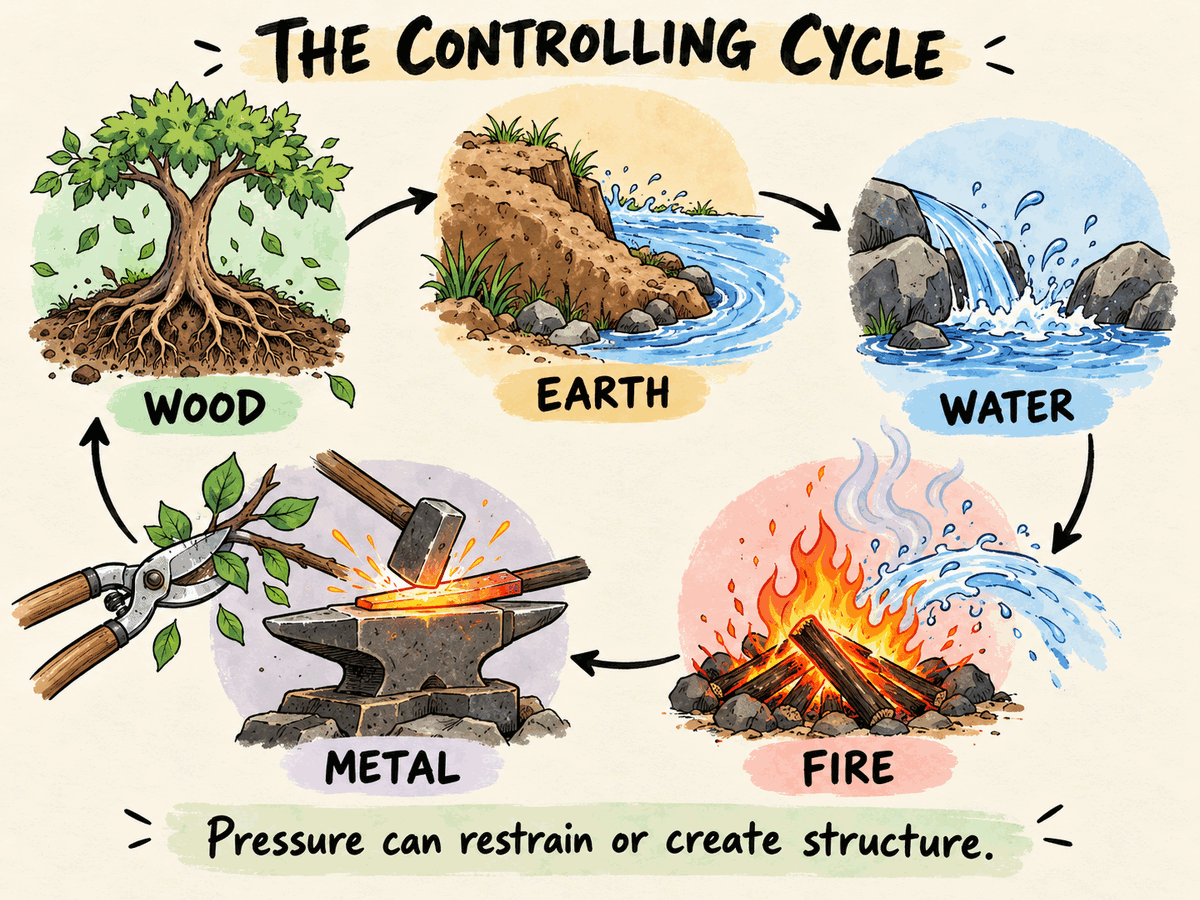
The controlling cycle (xiang ke, 相克) describes restraint. Roots hold and break soil; earth banks guide water; water cools fire; fire shapes metal; metal cuts wood. Control can point to conflict, limits or competition, but it can also show the structure that keeps a situation workable.
So “generates” is not always good, and “controls” is not always bad. A line that keeps feeding another may be depleted. A controlled line may be appropriately contained. Context decides. This is why interpreting an I Ching reading in context matters more than turning one relationship into a verdict.
Strength is a whole-chart judgment
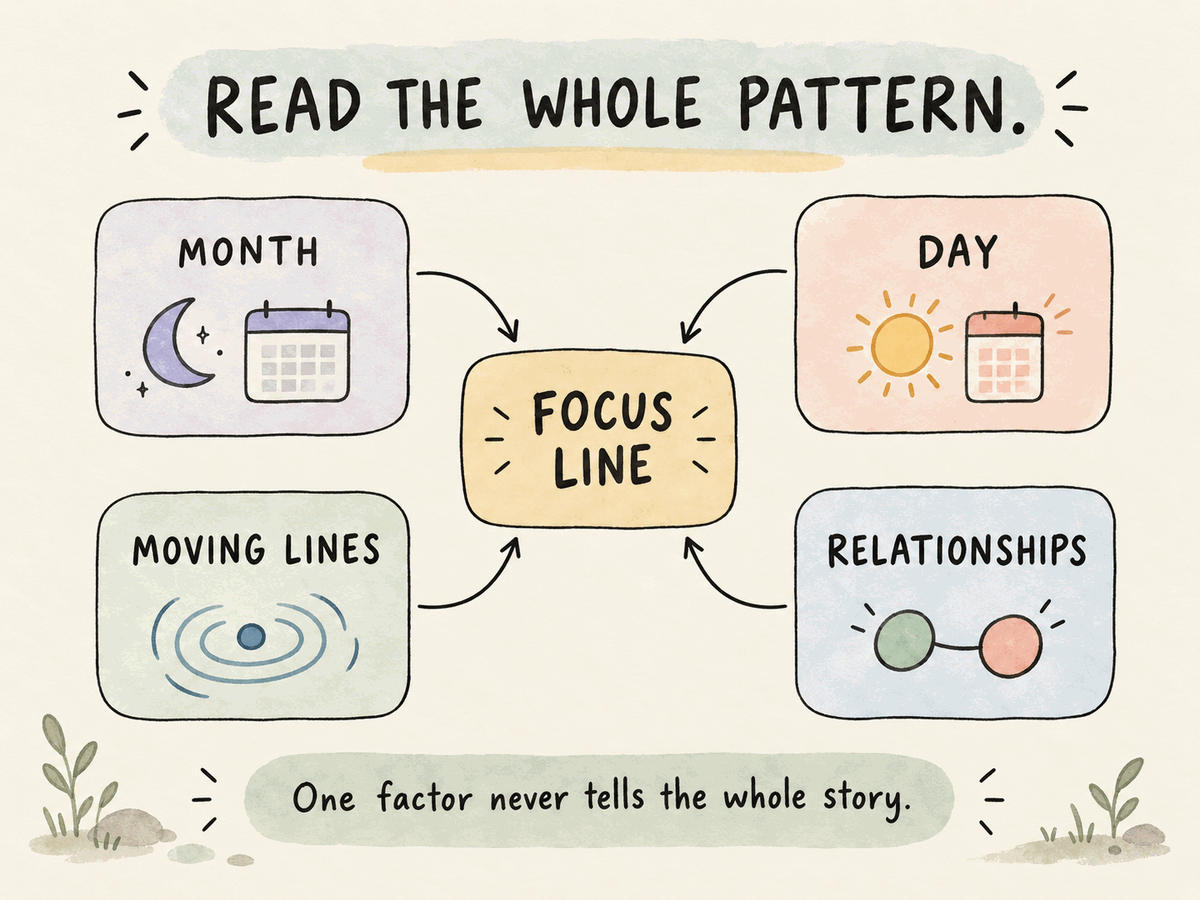
The month and day matter in Liu Yao because they describe the time environment of the cast. A focus line supported by the month may gain strength; one pressured by it may struggle. But a serious reading also checks the day, moving lines, combinations, clashes, emptiness and the line’s role in the question. One seasonal relationship never decides the answer alone.
Imagine an illustrative job-offer chart—not a real cast—where the focus line is Metal, the month is Earth and a moving Fire line applies pressure. Earth supports Metal, while Fire controls it. The useful question is not “Is Metal strong, yes or no?” It is “Which influence is active, timely and connected to the job question?” That shift prevents a neat diagram from becoming a mechanical prediction.
Try This Question in Sixseer
What should I understand about the support and pressure around my current situation, and which relationship in the Six Lines chart deserves the closest attention now?
Cast this focused question in Sixseer. Sixseer turns one question into a structured I Ching/Liu Yao reading: you cast the coins, the six lines are constructed in order, and AI-assisted plain-language guidance helps you examine relationships, movement and timing. For the mechanics, use the step-by-step coin-casting guide.
Frequently asked questions
Do I need to memorize both cycles?
No. Learn the direction of support and pressure, then keep a diagram nearby. Accurate interpretation depends more on applying the relationships to the right focus line than recalling them at speed.
Does the same element always mean friendship?
No. Same-phase lines are peers. Depending on the question, peers may cooperate, compete for the same resource or simply show repetition. The represented role and real situation decide.
Can the month alone tell me whether a line is strong?
No. The month is important, but the day, moving lines and structural relationships can strengthen, weaken or redirect what it suggests. “Read the whole pattern” is the safer beginner rule.
Are the Five Elements a scientific prediction model?
No. Wu Xing is a traditional interpretive framework. In Liu Yao divination it organizes symbolic relationships and timing; it does not replace evidence, professional advice or your ability to choose.
Read the movement, then return to reality
The Five Elements become practical when they help you name what is supporting a situation, what is constraining it and what may be changing. They are the grammar of the chart, not a verdict detached from life. Try a free Sixseer reading when you want to turn that grammar into a clearer next question and a grounded next step.
Sources
AI-assisted research and drafting were used by Sixseer Editorial. The article was checked against Sixseer’s current methodology and internal Liu Yao knowledge base; no real cast or guaranteed outcome is presented.