Liu Yao Divination Explained: A Beginner’s Guide to the Six Lines Method
Learn how Liu Yao uses six coin-cast lines, five elements, symbolic roles, and calendar timing to explore one focused question.
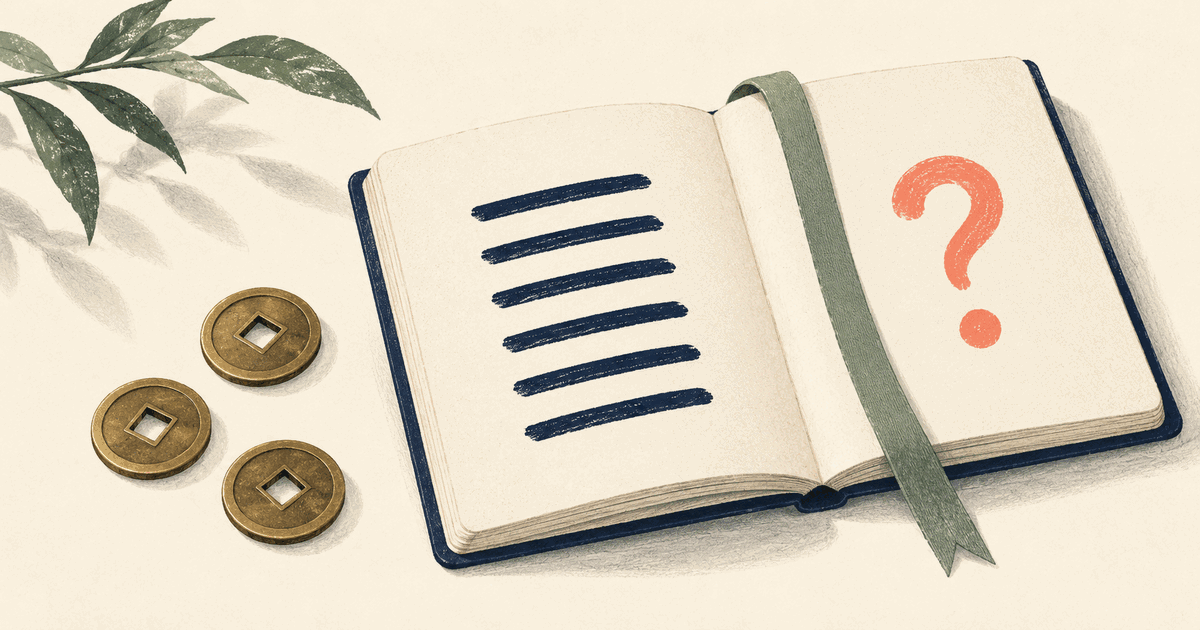
What is Liu Yao? Liu Yao is a Chinese divination method that uses six lines — each line solid or broken — to answer one specific question. You cast the six lines with three coins, then read the chart with the help of the Chinese calendar and the five elements. It is also called the Six Lines method or Wen Wang Gua. Here, “Liu Yao” means the traditional chart-based divination method, not simply the six lines of any hexagram.
If you have heard of the I Ching but never heard of Liu Yao, you are not alone. Many English introductions emphasize the hexagram and line texts of the Book of Changes. Liu Yao adds another layer: relationships between the lines, their elements, and the calendar. This guide explains that layer in plain English, step by step. For the broader picture first, read I Ching and Liu Yao in simple terms.
Why Does Liu Yao Look Different?
Reading the ancient text and analyzing a Liu Yao chart are different approaches within the wider I Ching tradition. Neither makes the other illegitimate. The Stanford Encyclopedia of Philosophy’s history of the Yijing describes its development as both a divination classic and a philosophical work. Learning one approach does not automatically teach you the other.
Liu Yao vs. the Classic I Ching Reading
Both methods start the same way: you ask a question and cast six lines. The difference is what happens next.
| Classic I Ching reading | Liu Yao (Wen Wang Gua) | |
|---|---|---|
| Based on | The ancient hexagram texts | The chart + the calendar + the five elements |
| Emphasis | Images, judgments, and line statements | Roles, support, obstacles, change, and timing |
| Common use | Divination and reflection through the text | Divination about a specific situation or decision |
| Needs to learn | The 64 hexagram texts | Six relatives, five elements, month-and-day influences |
Think of it this way: the classic reading is like reading a poem about your situation. Liu Yao is more like studying a symbolic weather chart: which forces support the matter, which resist it, and where change is gathering. This is an analogy for the reading process, not a scientific weather forecast.
The Six Pieces of a Liu Yao Chart
A finished Liu Yao chart looks busy at first. These six features give you a useful starting map:
- The hexagram. Six lines, built from the bottom up with three coins. Each line is yin (broken: ⚋) or yang (solid: ⚊).
- Moving lines. Some lines are “old” — they are changing into their opposite. These show where the action is.
- Stems, branches, and elements (Na Jia). The traditional Na Jia assignment attaches stems and branches to the lines. Each line has one of the twelve earthly branches of the Chinese calendar (like Rat, Ox, Tiger…), and each branch carries one of the five elements: wood, fire, earth, metal, or water.
- The six relatives. Each line is given a role based on its element: Parents, Siblings, Offspring, Wealth, or Official/Ghost. Despite the traditional name “six relatives,” these are five relationship labels used on the chart. These roles stand for the people and things in your question.
- The Self line and the Response line. One line marks you (the Self line). Another marks the other side — the person, company, or situation you are asking about.
- The month and day you cast. Calendar influences help a reader assess line strength and timing. Both matter; looking only at the day misses part of the method.
Do not try to memorize all of this. A charting tool can organize these labels for you. What matters is understanding the logic — which is simpler than it looks.
How to Read a Liu Yao Chart, Step by Step
Step 1: Cast your six lines
Hold one clear question in your mind. Toss three coins six times. Before starting, assign one coin face a value of 2 and the other a value of 3, then keep that convention unchanged. Add the three values for each toss: 6 is changing yin, 7 stable yang, 8 stable yin, and 9 changing yang. Record the first line at the bottom and build upward. A 6 or 9 is a moving line: it will change into its opposite and form a relating hexagram when the changing lines are flipped.
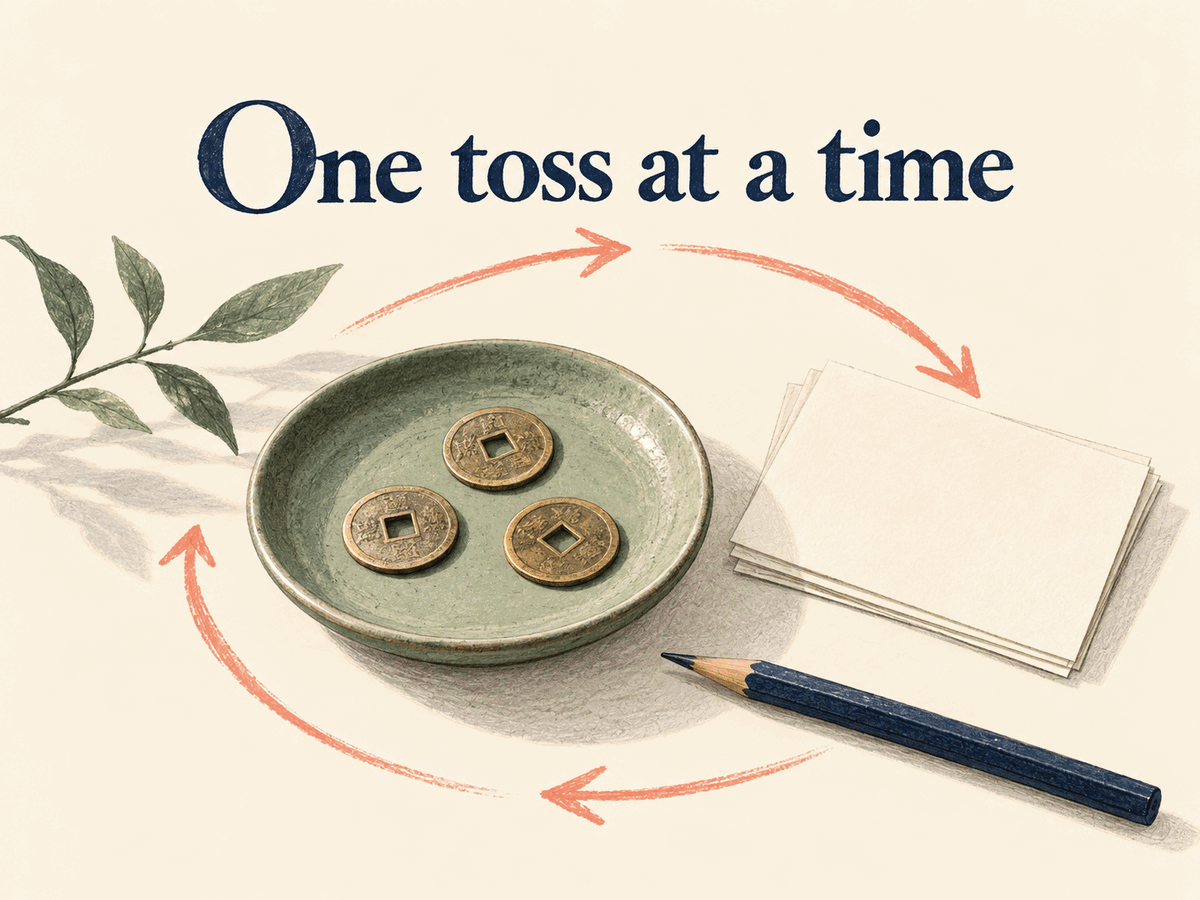
Step 2: Give every line an element
Through the Na Jia system (a fixed matching table), each line receives an earthly branch, and each branch has an element. Now your six lines are not just yin and yang — they are wood, fire, earth, metal, and water. This is what connects your question to real time, because the calendar is made of the same elements.
Step 3: Find the six relatives
Compare each line’s element with the hexagram’s main element (the “palace” element). The relationship gives the line its role:
- A line that feeds the main element = Parents (support, protection, documents, home)
- A line of the same element = Siblings (peers, friends, competitors, colleagues)
- A line that the main element feeds = Offspring (children, ideas, creative output, pets)
- A line the main element controls = Spouse/Wealth (money, partner, things you want to gain)
- A line that controls the main element = Official (career, bosses, pressure, rules)
The family names are symbolic roles, not a literal family tree. Five elemental relationships produce five labels; “six relatives” is the traditional collective term.
Step 4: Find yourself and your focus line
The chart marks one line as you (the Self line). Then, based on your question, you pick a focus line (traditionally called the “yong” line — the line your question is really about). Asking about money? Your focus line is the Wealth line. Asking about a job? The Official line. For a relationship question, selection depends on what is being asked and the interpretive convention; it is not automatically the Wealth line.
Step 5: Check who is strong, who is moving, and where things are going
Now the reading comes together. You ask three questions:
- Is my focus line strong or weak? A line is strong when the season, the month, and the day feed it or match it. Strength is one part of the traditional assessment, not a complete verdict by itself.
- What are the moving lines doing? Moving lines are events in motion. Generation and restraint may indicate support or pressure, but their meaning depends on the full chart and question.
- What does the changed hexagram show? The moving lines flip and form a second hexagram. In Liu Yao, the changed lines and their relationships deserve attention; the second hexagram’s name alone does not decide the outcome.
This is a beginner’s outline, not the entire method. Combinations, clashes, empty branches, hidden lines, and transformations can change a detailed reading. If you find yourself collecting conflicting meanings, use our guide to interpreting a reading without getting lost to keep the answer connected to your original question.
The Five Elements in One Minute
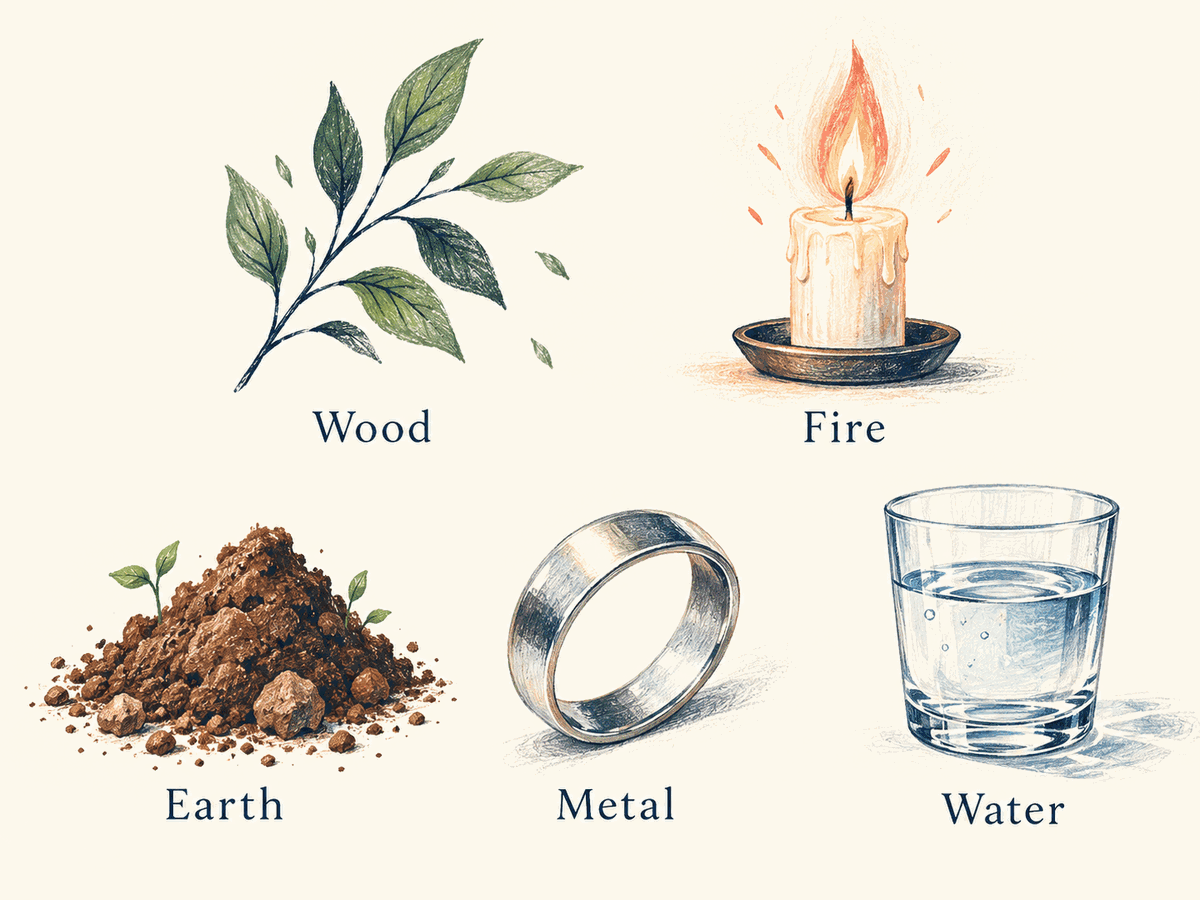
You only need two small cycles:
The feeding cycle (who helps whom): Wood feeds Fire → Fire feeds Earth → Earth feeds Metal → Metal feeds Water → Water feeds Wood → back to Wood. Think of firewood feeding a flame, or rain feeding a forest.
The controlling cycle (who pushes whom): Wood controls Earth → Earth controls Water → Water controls Fire → Fire controls Metal → Metal controls Wood → back to Wood. Think of tree roots breaking soil, or a dam holding back water.
In a reading, “feeding” means support, giving, and growth. “Controlling” means pressure, effort, or conflict. Same-element lines mean peers — teamwork or competition, depending on the question.
A Practical Example: “Should I Take the New Job?”
Imagine receiving an offer that looks exciting but leaves you unsure about the team and the timing. Before casting, write down the decision deadline and what attracts or worries you.
A focused Liu Yao reading would examine the line representing the matter, its relationship to the Self line, calendar support, and any moving-line interactions. You would then compare the interpretation with concrete questions: Is the role clear? Does the manager answer directly? What preparation is still missing?
No cast is supplied here, so no hexagram or outcome is assigned. This example shows how to frame the question, not a divination result. For a related career application, explore an I Ching reading for leaving a job.
Try This Question in Sixseer
What should I understand about accepting this job offer before my reply deadline, including the support available, the main obstacle, and the timing of the change?
Explore this job-offer question in Sixseer, then note what you want to check with the employer.
What Questions Work Best for Liu Yao?
Liu Yao shines with one clear, concrete question about a real situation. Good examples:
- “What should I know about this job offer?”
- “Is this a good time to launch my project?”
- “What is really going on between me and my partner?”
- “Will this business trip go smoothly?”
It works poorly with vague or repeated questions like “What does my future hold?” or asking the same question five times until you like the answer. A useful practice is one focused question, one recorded cast. Revisit it before asking again simply because the answer feels uncomfortable.
Common Mistakes Beginners Make
- Skipping the question. A fuzzy question gives a fuzzy reading. Write your question down before you cast.
- Reading the hexagram text like the classic method. In Liu Yao, the ancient text is background music — the chart is the main voice.
- Ignoring the calendar. A line that looks weak can be strong in the right season, and the other way around. The day you cast is part of the reading.
- Demanding a verdict without context. Yes-or-no questions are part of traditional divination. For a useful beginner reading, add the specific situation and time frame, and ask what supports or obstructs the outcome.
- Casting again for a better answer. If you did not like the reading, the honest move is to reflect on it — not to re-roll the dice.
Frequently Asked Questions
What is the difference between Liu Yao and Wen Wang Gua?
They are two names for the same method. Liu Yao means “six lines.” Wen Wang Gua means “the divination of King Wen” — the legendary king linked to the I Ching. Both names describe the six-lines system that adds the calendar and five elements to a hexagram reading.
Is Liu Yao the same as the I Ching?
Liu Yao is built on the I Ching — it uses the I Ching’s hexagrams, commonly formed with three coins. But it reads the result differently: instead of studying the ancient text, it analyzes the chart with the five elements and the day’s energy.
Do I need to learn Chinese to use Liu Yao?
No. Every term has a plain-English meaning: the traditional relatives labels describe symbolic roles, the Self line is “you,” and the five elements are wood, fire, earth, metal, and water. A good tool translates the whole chart for you.
How long does it take to learn?
The casting sequence is short to learn. Reading a chart well takes study and practice with the calendar, elemental relationships, and real cases. AI-assisted guidance can help explain the terms while you learn.
Is Liu Yao fortune-telling? Yes. Liu Yao is a traditional Chinese divination method used to examine likely developments, relationships, obstacles, and timing. It can also prompt reflection, but calling it only reflection misses its divinatory purpose.
Can I get a Liu Yao reading online?
Yes. Online tools can cast the coins, build the full chart (branches, elements, relatives, moving lines), and explain it in plain language.
Try a Liu Yao Reading Yourself
Reading about the method is useful; trying it is better. Sixseer combines all three layers in one place: traditional coin casting, six-line reading structure, and AI-assisted interpretation in plain English. Its ask–cast–reflect methodology keeps your question, line pattern, and explanation together. Begin your first free Liu Yao reading with one situation you genuinely want to understand.
Sources and editorial note
- Stanford Encyclopedia of Philosophy: Chinese Philosophy of Change — historical and philosophical context.
- Sixseer Methodology — current product reading flow.
Adapted from the supplied manuscript with AI-assisted editing on September 26, 2026. The everyday example is an illustration of question framing, not a documented cast.