You’re Still Editing. Is the Work Unfinished—or Are You Afraid to Release It?
If you keep revising without finishing, use Meaning–Reader–Release and a focused I Ching question to choose a final pass, feedback, or release.

Prepared with AI-assisted research and drafting under Sixseer’s editorial and methodology standards.
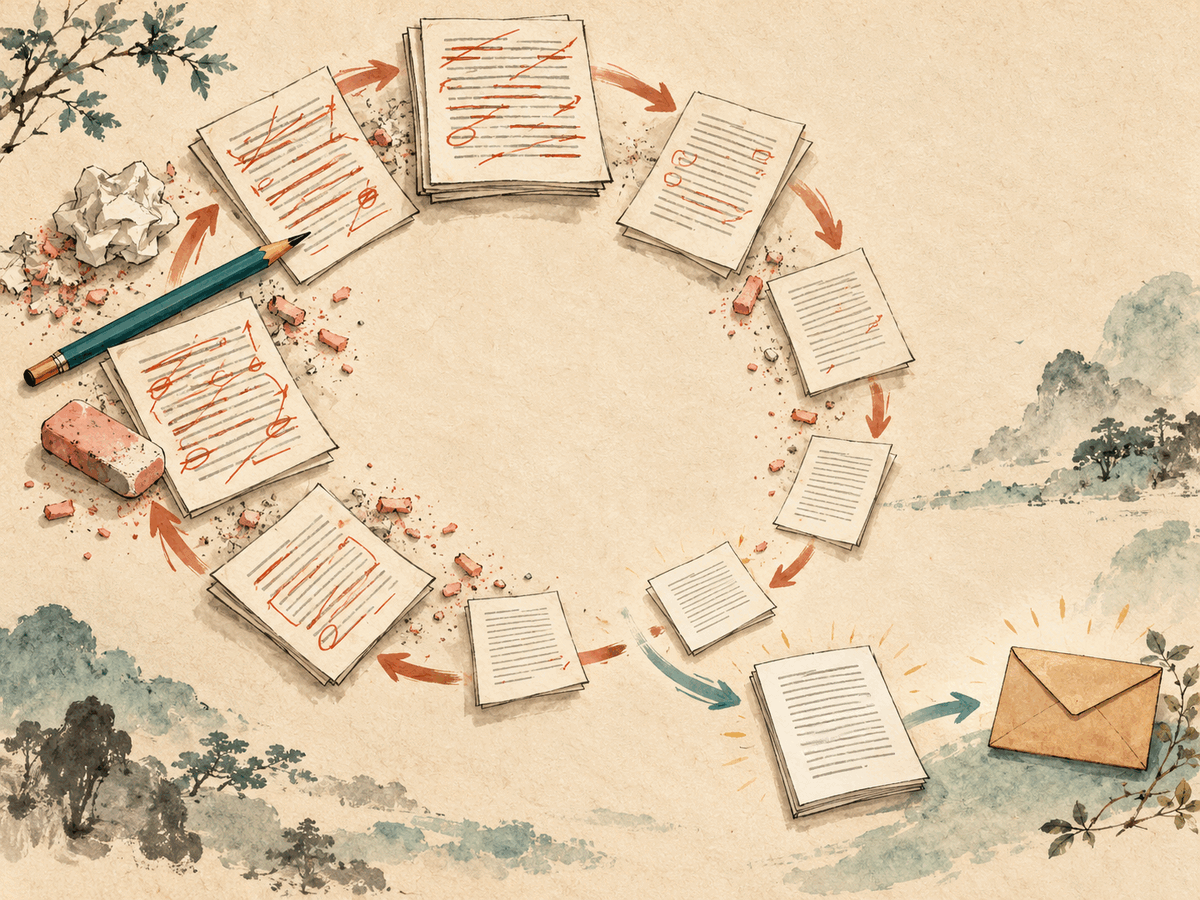
When every new pass changes a comma, swaps two lines, then changes them back, the project may no longer need more editing. It may need a finish decision. That does not make you lazy or careless. It means craft and fear have become hard to tell apart, especially when releasing the work will let other people see what you cannot perfect.
Good revision changes the work; anxious revision changes the discomfort
High standards are not the enemy. Research distinguishes striving for excellence from perfectionistic concern: a meta-analysis found that fear-laden perfectionistic concerns were positively associated with procrastination, while perfectionistic strivings showed the opposite pattern. In creative work, experiments also suggest that generating original ideas can increase both autonomy and fear of judgment.
So ask a concrete question: What became clearer, truer, more coherent, or more usable in this pass? If you can name the change, keep revising. If the only result is temporary relief—“now nobody can criticize that sentence”—you may be managing exposure, not improving the project.
Use the Meaning–Reader–Release finish test
Meaning: Does the project now say or do what you intended? List the one remaining problem that would materially distort the work. “It could be better” is not specific enough.
Reader: Can one trusted person understand the intended experience without you explaining every choice? Ask for one kind of feedback—clarity, pacing, usability—not a general verdict on your talent.
Release: Choose what “done for this version” means. That might be one final proofread, fixing three named issues, or submitting by Friday. Release does not declare the work flawless; it ends this decision window.
This is deliberately different from the visibility shock that can arrive after sharing. Here, the audience is still imaginary, and endless editing keeps the work from meeting any real reader at all.

Let an I Ching reading examine the timing—not grade the art
The I Ching is most useful here when you ask about the active pattern: preparation, avoidance, feedback, timing, or release. The Stanford Encyclopedia of Philosophy’s Yijing overview describes divination as interpretation that considers the past, present conditions, and possible action—not a fixed verdict.
Sixseer is an online I Ching and Six Lines tool that turns one focused question, a coin cast, and six correctly constructed lines into AI-assisted plain-language reflection. Practical accuracy depends on focused wording, consistent casting, correct bottom-up line construction, contextual interpretation, and comparison with the actual project. If you are new to the method, see how I Ching and Liu Yao work together.
Changing lines can help you notice where the situation still has movement. A reading might direct attention toward one unresolved structural issue, the need for an outside reader, or the cost of waiting. It cannot promise applause or declare the work objectively perfect.
Try This Question in Sixseer
Copy-ready question: “What should I understand about why I keep revising this project, and does the present pattern support one final pass, outside feedback, or releasing it now?”
Use the reading to choose one observable next step: name the final issue, send the work to one reader, or set a release date. Ask this focused question in Sixseer for free.

A small scenario: the final pass that keeps moving
A creator has edited the same essay for two years. Each Sunday she chooses a “last pass,” then rewrites the opening because submission suddenly feels close. She applies Meaning–Reader–Release: the argument is intact; one reader flags a confusing middle section; she fixes that section, proofreads once, and submits. The fear remains. The decision stops moving.
Frequently asked questions
How do I know whether revision is still improving the work?
Compare versions against a named goal. If a change improves clarity, structure, accuracy, emotional effect, or usability, it has a job. If it merely makes the work different or briefly lowers anxiety, save the earlier version and stop that pass.
Should I ask one more person for feedback?
Only if you can name what the reader should test. One specific question can reveal a blind spot. A growing jury of opinions often replaces your finish decision with a popularity contest.
Can I cast again if the answer feels unclear?
First clarify the original question and translate the reading into one real observation. The guide to interpreting an I Ching reading without multiplying meanings can help. Cast again only when the situation or decision has materially changed.
Your work does not have to feel safe to be finished
Finishing is not the moment you eliminate every possible criticism. It is the moment further revision stops serving the project’s meaning and starts serving the wish to avoid being seen. Protect the craft, choose a clear finish line, and let the work meet reality.
Use a free Sixseer reading to choose between final revision, feedback, and release—then make one decision that no longer moves with your fear.